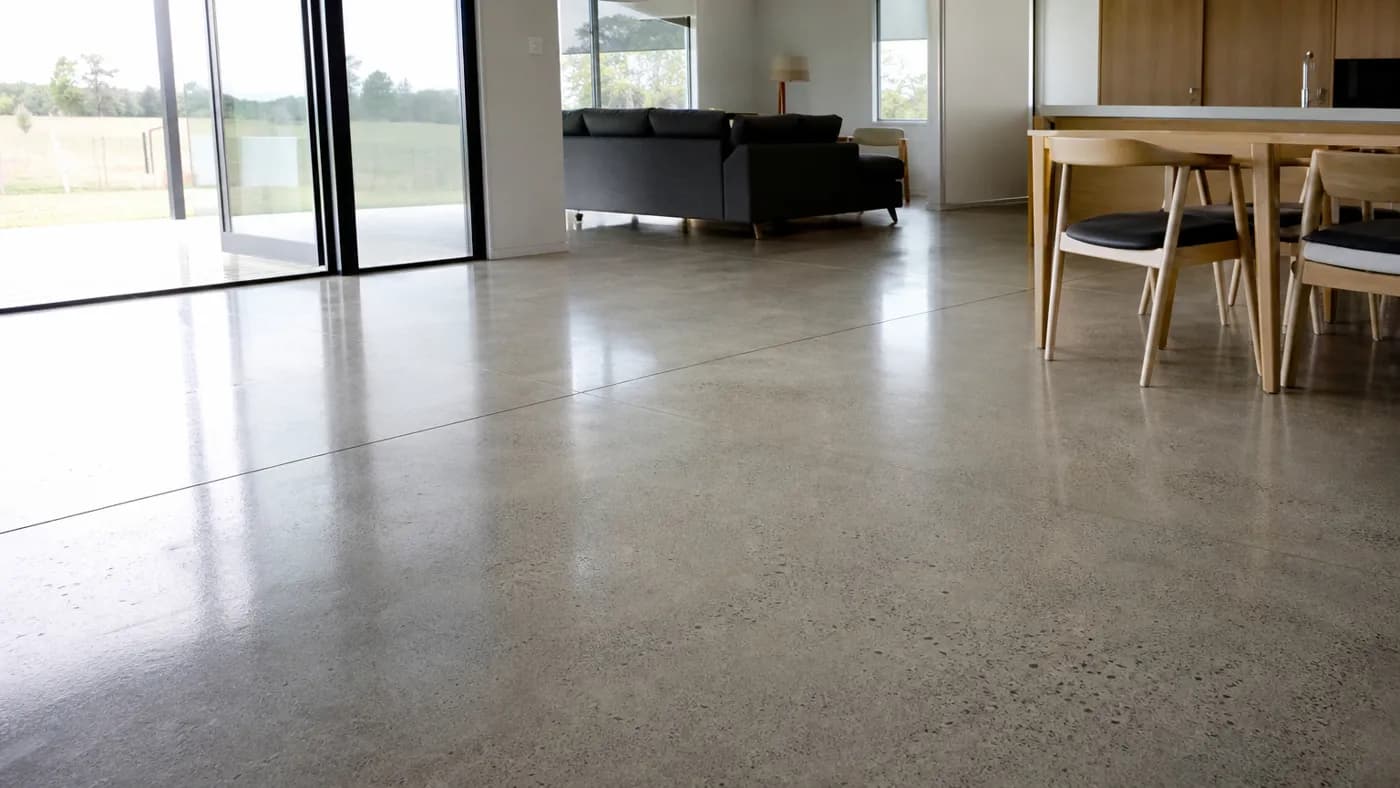
How concrete polishing works
Heavy grinding machines take the surface down in steps, much like sanding wood, starting with coarse diamond abrasives and moving to finer resin-bond ones. After the first grind, many contractors apply a penetrating hardener, often called a densifier, that soaks in and hardens the surface so it takes a better polish. The finer the last grit, the higher the shine. Color can be added with dyes or stains partway through.
| Level | Sheen | Where the grind stops |
|---|---|---|
| 1 | Flat, hazy, little reflection | Below 100-grit resin |
| 2 | Satin, low sheen | 400-grit resin |
| 3 | Semi-polished, good reflection | 800-grit or higher |
| 4 | Highly polished, mirror-like | Finer grits beyond level 3 |
Those levels follow the classes set out by the Concrete Polishing Association of America. Aggregate exposure is a separate choice: a light grind shows only the cream at the surface, while a deeper grind shows salt-and-pepper sand or larger stones.
Which slabs can be polished
Most sound slabs can be polished, new or old. A new slab should be in place at least 28 days before polishing starts so it has cured. On an existing slab, the condition decides the result: cracks, patches, old tack strip holes and glue residue will all show in a polished floor. If a slab is badly damaged, a polished overlay or a different floor may be a better choice.
- New ADU or addition: tell the concrete contractor before the pour that the slab will be polished. Finishing, curing and protecting it during construction all affect the final floor.
- Garage conversion: garage slabs often slope toward the door and carry oil stains; ask what grinding can and cannot remove.
- Under old carpet or tile: expect adhesive removal and patching before polishing, and ask how patches will look.
Polished concrete cost per square foot
Concrete Network publishes these national ranges for grinding, polishing and decorative work on an existing slab. They are not Sacramento quotes, and a new slab is extra.
| Tier | Typical range | Usually includes |
|---|---|---|
| Basic | $3–$5 per sq ft | Moderate shine, one stain color, minimal prep |
| Mid-range | $5–$8 per sq ft | Glossier finish, two colors or simple scoring, more prep |
| High-end | $8–$12+ per sq ft | Complex designs, stencils, extensive grinding |
Small rooms often cost more per square foot because setup is the same as for a large floor. Edges, closets and stairs need smaller tools and take longer.
Dust, silica and moving out
Grinding concrete creates fine dust containing crystalline silica, and Cal/OSHA's silica standard (Title 8, section 5204) covers cutting, grinding and demolition of concrete. Ask how the contractor controls dust, whether they grind wet or dry with a vacuum system, and how long the room needs to be empty. Plan to move furniture out and keep people and pets away while work is under way.
Hiring for polished concrete
- Ask for the final grit and the polish level in writing, plus whether a densifier and a guard or sealer are included.
- Ask to see a finished floor they did, ideally a residential one.
- Ask how joints and cracks will be treated: filled, left open or highlighted.
- Verify the license at cslb.ca.gov. Concrete work is typically under a C-8 Concrete license.
Polished concrete is an interior finish. For outdoor color, see stained concrete or decorative concrete; for a new slab under an addition or ADU, see concrete slabs. Send a request with the room size and what is on the floor now.
Main guide: concrete contractors in Sacramento.