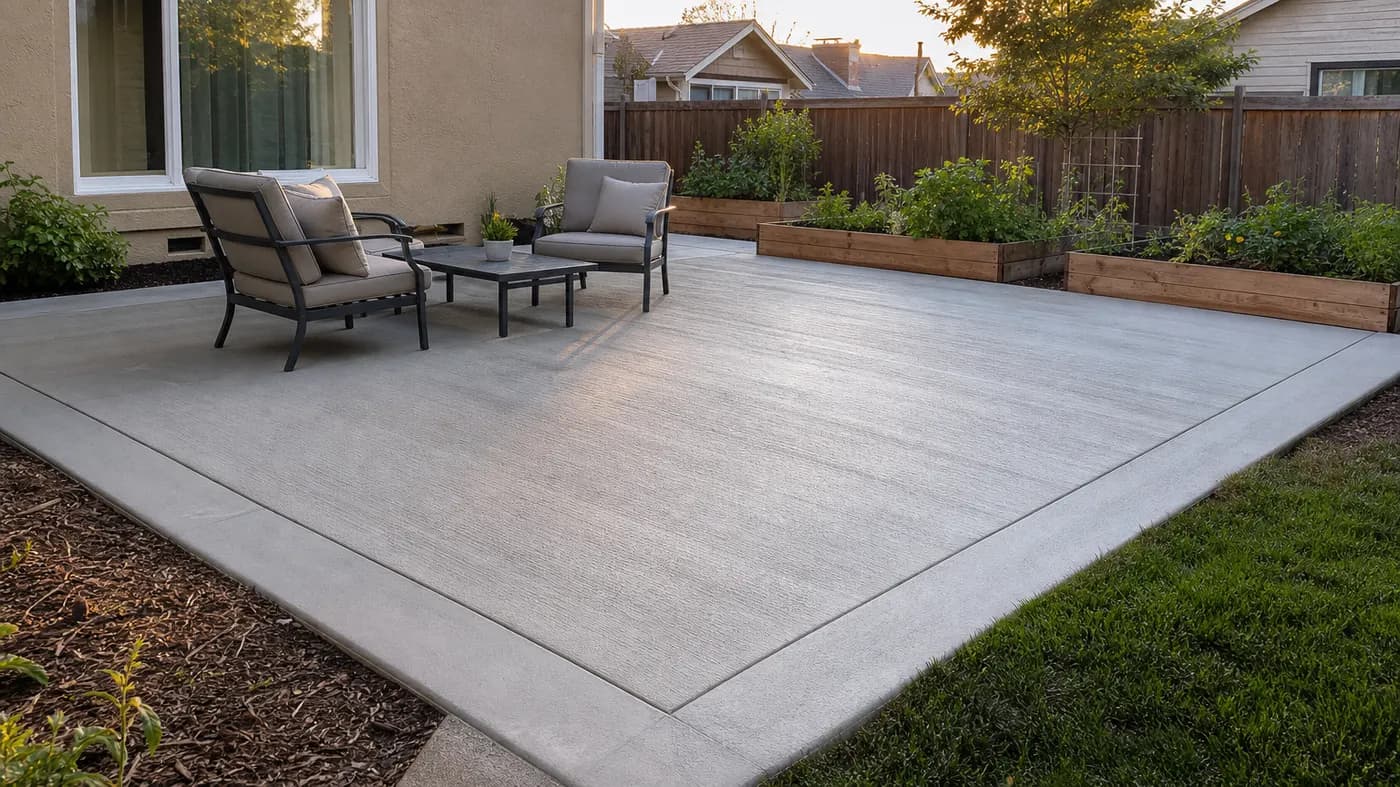
Concrete patio finishes
Most patios use one or two finishes. The photo above shows a common combination: a smooth trowel-edged border framing a broom-finish center. The border gives crisp edges, and the broom texture gives grip when the surface is wet.
| Finish | Look and feel | Notes |
|---|---|---|
| Broom finish | Light ridged texture | Plain and non-slip; lowest cost; common for patios and walkways |
| Smooth trowel | Flat, slick | Better for borders and indoor-style areas; can be slippery when wet outdoors |
| Stamped | Stone, slate or brick pattern | See stamped concrete; higher cost, needs sealing |
| Exposed aggregate | Pebbled surface | See exposed aggregate concrete |
| Colored or stained | Earth tones or custom color | See decorative concrete |
For a patio next to a pool, the surface and its slip resistance deserve extra attention. That is covered on the concrete pool decks page.
Concrete patio cost per square foot
These are typical national ranges from published cost guides. No Sacramento-specific per-square-foot figure was found, so local quotes decide the real price. A contractor can visit, measure and quote the patio, and a request through this site costs nothing.
| Patio level | Typical national range (installed) |
|---|---|
| Plain | $5–$8 per sq ft |
| Simple | $8–$11 per sq ft |
| Custom | $11–$18 per sq ft |
| Elaborate | $18+ per sq ft |
| Colored concrete (add-on) | +$2–$6 per sq ft |
| Exposed aggregate (add-on) | +$3–$8 per sq ft |
For scale, a 12 by 16 foot patio is 192 square feet, which at the plain-to-custom range is roughly $960–$3,456 before any removal, grading or extras. That is arithmetic on the national numbers, not a quote. Removal of an old slab is a separate line at about $2–$6 per square foot (see concrete removal). For the full cost picture see concrete cost in Sacramento.
Thickness, joints and base
A patio is lighter duty than a driveway, but it is still a slab that moves with the ground. Four inches is the commonly cited minimum thickness for a residential driveway carrying passenger vehicles. Ask the contractor what thickness and base they plan.
Control joints should be planned before the pour. A common rule is to space them 24–36 times the slab thickness (8–12 feet for a 4 inch slab) and cut them at least a quarter of the way through. On a small patio, one or two joints may be enough. On a long, narrow patio or one with an L-shape, joints at the inside corners help steer cracks, since sharp interior corners are where concrete tends to crack. Ask where the joints will go.
Slope matters too. A patio should drain water away from the house and not toward it, so ask the contractor how the surface will be graded. For where the slab sits relative to the house foundation and any raised planters, bring the contractor out to look at the yard rather than relying on measurements from photos.
Sacramento soil and heat
Sacramento County has widespread hardpan and clay layers. The county's own soils chapter describes a cemented hardpan (duripan) a few feet below the surface in places, and some soil series (San Joaquin, Redding) have a high shrink-swell potential. Soils in the foothills east of the valley differ. Expansive clay and hardpan are common, so subgrade preparation matters, and it is worth asking how the contractor handles the base under the slab. See concrete slabs for more on slab preparation.
Heat matters at pour time. Sacramento's normal July high is about 93–94°F, with about 20+ days a year at 100°F or hotter. Hot weather speeds up hydration and evaporation in fresh concrete, so the surface can stiffen faster than the finisher expects. Curing is the fix: keep the concrete continuously moist for about 7 days, and shield it from sun and wind with damp burlap or curing blankets in hot weather. Ask your contractor how curing will be handled and when you can put furniture on it.
Permits and setbacks for a concrete patio
The California Building Code exempts sidewalks and driveways not more than 30 inches above adjacent grade, not over a basement or story below, and not part of an accessible route. Patios are not named in that list, and local jurisdictions generally treat at-grade patio slabs as exempt under the same logic, but rules differ by city. Citrus Heights, for example, lists walks and driveways as exempt on its permit page and does not list patios. Exempt work still has to meet code and zoning, including setbacks.
- A patio that is raised, sits over a basement, or is attached to a structure is more likely to need a permit. Ask your city or county.
- A roof, pergola or other structure over a patio is a separate question for your building department.
- In the City of Sacramento, work in the public right-of-way needs an encroachment permit; a private backyard patio does not cross it. Confirm with your jurisdiction.
- Exempt work in a design review or historic district may still need review. Confirm before you start.
Planning the patio before you ask for quotes
A few decisions made up front make quotes easier to compare. Contractors price what you describe, so the more specific you are, the closer the numbers will be to each other.
- Size and shape. Measure the area, and decide whether you want straight edges or curves. The cost guides above are priced per square foot, so area drives the total.
- Finish. Broom, smooth border, stamped, aggregate or colored. The finish is the biggest swing in the price per square foot.
- What is there now. If there is an old patio, lawn, or a pad that has to come out, removal is a separate line at about $2–$6 per square foot nationally.
- What will sit on it. Furniture, a fire pit, a grill or a hot tub all change the loads and the layout.
- Where the water goes. Note downspouts, sprinklers and low spots in the yard, and show them to the contractor.
- Sun and heat. Sacramento summers are hot, so think about shade and surface color, and ask the contractor about options.
If the plan includes steps from a door, a raised planter or a walkway to the gate, see concrete steps and concrete walkways and sidewalks, since these are often priced and poured together.
Hiring a licensed concrete contractor for a patio
Sacramento Crest Concrete is a referral service. We pass your contact information to licensed local contractors, and you contract with and pay the contractor directly. Verify the license at cslb.ca.gov. The C-8 Concrete classification covers forming, pouring, placing and finishing flat concrete work.
- California caps a home improvement down payment at $1,000 or 10% of the contract, whichever is less.
- Most home improvement contracts have a three business day right to cancel (five if you are 65 or older).
- Get thickness, finish, joint layout, drainage slope, removal and cleanup in writing.
- If you want the patio colored, stamped or sealed, ask whether that is in the quote or a separate line.
If you already have a patio with problems, see concrete repair or concrete resurfacing.
Main guide: concrete contractors in Sacramento.