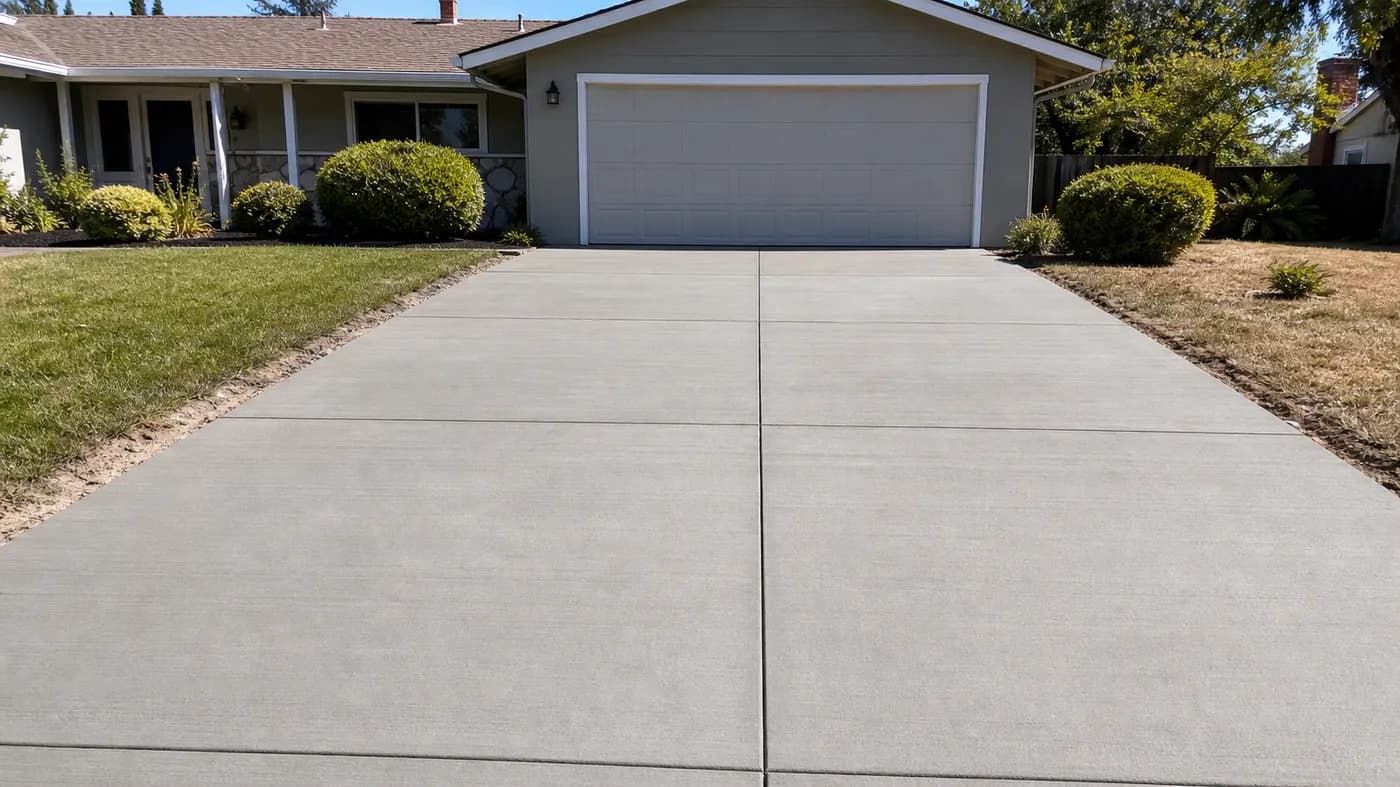
What a concrete driveway job includes
A concrete driveway is more than the pour. The contractor lays out the shape, excavates, prepares and compacts the base, sets wood forms along the edges, places the concrete, finishes it and cuts or tools joints so the slab cracks where you want it to. Then the concrete has to cure. Most homeowners ask about the finish, but the base preparation and the curing decide how the driveway looks in ten years.
The most common finish is a broom finish: a light texture dragged across the surface for traction. It is plain, drains water well and costs the least. Other options include stamped concrete, exposed aggregate concrete and colored concrete. For the whole menu see decorative concrete.
If you are tearing out an old driveway rather than building on bare ground, the job also includes demolition and haul-off. That version is covered on the driveway replacement page.
Concrete driveway cost per square foot
These are typical national ranges from published cost guides, not Sacramento prices. No Sacramento-specific per-square-foot data was found, so the real number comes from local quotes. Contractors can visit to measure the driveway and quote it. A request through this site costs nothing and does not obligate you.
| Driveway type | Typical national range (installed) |
|---|---|
| Plain or broom-finish concrete | $6–$12 per sq ft |
| Stamped concrete | $12–$25 per sq ft |
| Exposed aggregate (add-on to base cost) | +$3–$8 per sq ft |
| Colored concrete (add-on) | +$2–$6 per sq ft |
| Removal of old concrete, if needed | $2–$6 per sq ft |
For scale, a 20 by 20 foot two-car apron is 400 square feet, which at the plain-concrete range works out to roughly $2,400–$4,800 before any removal, curb work or extras. That is arithmetic on the national range, not a quote. For the full picture see concrete cost in Sacramento.
Thickness, strength and joints
Thickness and strength
Four inches is the commonly cited minimum thickness for a residential driveway carrying passenger vehicles, and residential driveway concrete is commonly specified in the 3,500–4,000 psi range. If you park a heavy truck, RV or trailer on the driveway, say so up front and ask the contractor what thickness and base they recommend. Local agencies set their own numbers for work in the public right-of-way: the City of Roseville, for example, requires 6 inch sidewalks and Class A six-sack concrete in its minor sidewalk and driveway encroachment requirements, which shows a local standard can exceed the minimum.
Control joints
Concrete shrinks as it cures, and it will crack somewhere. Control joints are planned weak lines that steer the cracking. A common rule is to space joints 24–36 times the slab thickness, so a 4 inch driveway gets joints about every 8–12 feet in each direction, cut at least one quarter of the thickness deep (1 inch for a 4 inch slab). Joint layout is easy to ignore on a quote and obvious in photos of finished work. Ask where the joints will go before the pour. A driveway cut into squares with joints that meet corners cleanly looks intentional; random cracks across a slab do not.
Sacramento soil and the base under your driveway
Sacramento County has widespread restrictive soil layers. The county's own soils chapter describes a cemented hardpan (duripan) a few feet below the surface in places, and says claypans and duripans are common in the low-terrace soils. Some soil series, including San Joaquin and Redding soils, have a high shrink-swell potential, meaning they expand when wet and shrink when dry. Soils differ again in the eastern county and the foothills, so a driveway in Elk Grove and one near Folsom may sit on different ground.
What this means in practice: expansive clay and hardpan are common here, and subgrade preparation matters. Ask the contractor how the subgrade will be prepared and compacted, and what base material goes under the slab. For city right-of-way work, Roseville's requirement is 95% relative compaction of the subgrade, which gives you a sense of what a written standard looks like. See concrete slabs for more on the base.
Pouring and curing in Sacramento heat
Sacramento's normal July high is about 93–94°F, with about 20+ days a year at 100°F or hotter (the record is 45 days in 2024). Heat speeds up hydration and evaporation in fresh concrete, which can make the surface set and dry out sooner. That is why curing matters more here than in a mild climate.
- Curing means keeping the concrete continuously moist, typically for about 7 days. Concrete kept moist for 7 days is cited as roughly 50% stronger than uncured concrete.
- In hot weather the surface should be protected from sun and wind, for example with damp burlap or curing blankets.
- Ask your contractor when you can walk on it and when you can drive on it, and keep cars off until they say so.
Rain also matters. Roseville's right-of-way rules prohibit pouring or finishing in rain, a sensible rule for any driveway. The rainy-season months are best confirmed with your contractor's schedule rather than assumed.
Permits and the driveway approach in Sacramento
The California Building Code generally exempts sidewalks and driveways from a building permit when they are not more than 30 inches above adjacent grade, not over a basement or story below, and not part of an accessible route. Exempt work still has to meet code and zoning, such as setbacks. The more common issue is the driveway approach, the part that crosses the public right-of-way between your lot and the street. Confirm everything below with your city or county before work starts.
| Where you live | What the sources say | Confirm with |
|---|---|---|
| City of Sacramento | A driveway that abuts rolled (mountable) curb or an alley needs no driveway permit. A new or modified driveway that needs a curb cut needs a Driveway Permit. Rebuilding an existing inlet at the same width needs an Encroachment Permit. | Development Engineering, 916-808-8300 |
| Unincorporated Sacramento County (Carmichael, Fair Oaks, Antelope, Orangevale and others) | Driveway approaches in county right-of-way need an Encroachment Permit from SacDOT, obtained by the property owner or representative before construction. | SacDOT |
| Elk Grove | The city's permit page indicates an encroachment permit for driveway approach work in the right-of-way. | Elk Grove building and public works |
Other cities and counties publish their own rules, and some we could not confirm, so ask the contractor who pulls permits for your address and check with your jurisdiction. If your lot is in the foothills or on a slope, see concrete contractors in Folsom or concrete contractors in Roseville for local notes.
City of Sacramento width and length rules
The City of Sacramento's driveway permit instructions cite city code 17.508.050: driveways are 10–12 feet wide for a single-car driveway and up to 20 feet for two cars, and 20 feet long measured from the property line (18 feet in the Central City). Under 17.508.040 E, no driveway can sit within 10 feet of a pedestrian ramp. The permit package includes an application, site plan, traffic control plan and proof of liability insurance, and work may begin only after the permit is issued. The fee varies by driveway width. If you want a driveway wider than the code allows, that is a conversation with the city before it is a conversation about concrete.
Hiring a licensed concrete contractor
Sacramento Crest Concrete is a referral service. We pass your contact information to licensed local contractors; we do not solicit or negotiate contracts for them. You contract with the contractor directly and pay the contractor directly. Verify the license at cslb.ca.gov before you sign anything.
- The CSLB's C-8 Concrete classification covers forming, pouring, placing and finishing flat and pavement concrete work. Grading and base work may fall under C-12 Earthwork and Paving; ask how the job is licensed.
- California caps a home improvement down payment at $1,000 or 10% of the contract, whichever is less.
- Home improvement contracts generally carry a three business day right to cancel (five if you are 65 or older).
- Ask who applies for the encroachment or driveway permit, and get the joint layout, thickness and curing plan in writing.
Main guide: concrete contractors in Sacramento.