What a concrete slab or pad is used for
A slab is a flat, poured concrete surface supported by compacted ground rather than by walls or footings. In residential work that covers a wide range of uses, and the use drives the specification.
| Use | What to tell the contractor |
|---|---|
| Shed pad | Shed size and floor type, what will be stored, and whether it will have a vehicle or heavy equipment on it |
| Hot tub or spa pad | Filled weight from the manufacturer, and where electrical and drainage will run |
| AC or equipment pad | Unit size and clearance needs; ask the equipment installer for requirements |
| Workshop or garage floor | Vehicle and equipment loads, and whether the slab ties into a building (see concrete foundations) |
| Patio or outdoor kitchen base | See concrete patios for finishes, drainage and joints |
For a driveway, walkway or steps, see concrete driveways, concrete walkways and sidewalks and concrete steps.
Concrete slab cost per square foot
These are typical national ranges from published cost guides, not Sacramento prices. No Sacramento-specific per-square-foot data was found. A contractor can visit, measure and quote a slab, and a request through this site costs nothing.
| Slab type | Typical national range (installed) |
|---|---|
| Most homeowner slabs | $4–$8 per sq ft |
| Wider range across guides | $4–$12 per sq ft |
| Basic, low end of some guides | As low as about $3 per sq ft |
| Reinforced, upper end | Above $10 per sq ft |
| Removing an old slab first | $2–$6 per sq ft |
A 10 by 12 foot shed pad is 120 square feet, which at $4–$12 works out to about $480–$1,440. That is arithmetic on the national range, Price per square foot also depends on thickness, reinforcement, access for equipment, grading and finish. Use the concrete slab cost guide to see how a quote breaks down. A slab-on-grade foundation for a house is a different job, and we have no published price for it.
Thickness, strength and reinforcement
Four inches is the commonly cited minimum thickness for residential concrete carrying passenger vehicles, and it is a typical starting point for a shed pad or equipment pad. Residential driveway concrete is commonly specified at 3,500–4,000 psi. For a heavier load, such as a spa filled with water, a workshop with a car lift or a trailer, ask the contractor what thickness, strength and reinforcement they recommend and why. Ask for the reinforcement specification in writing.
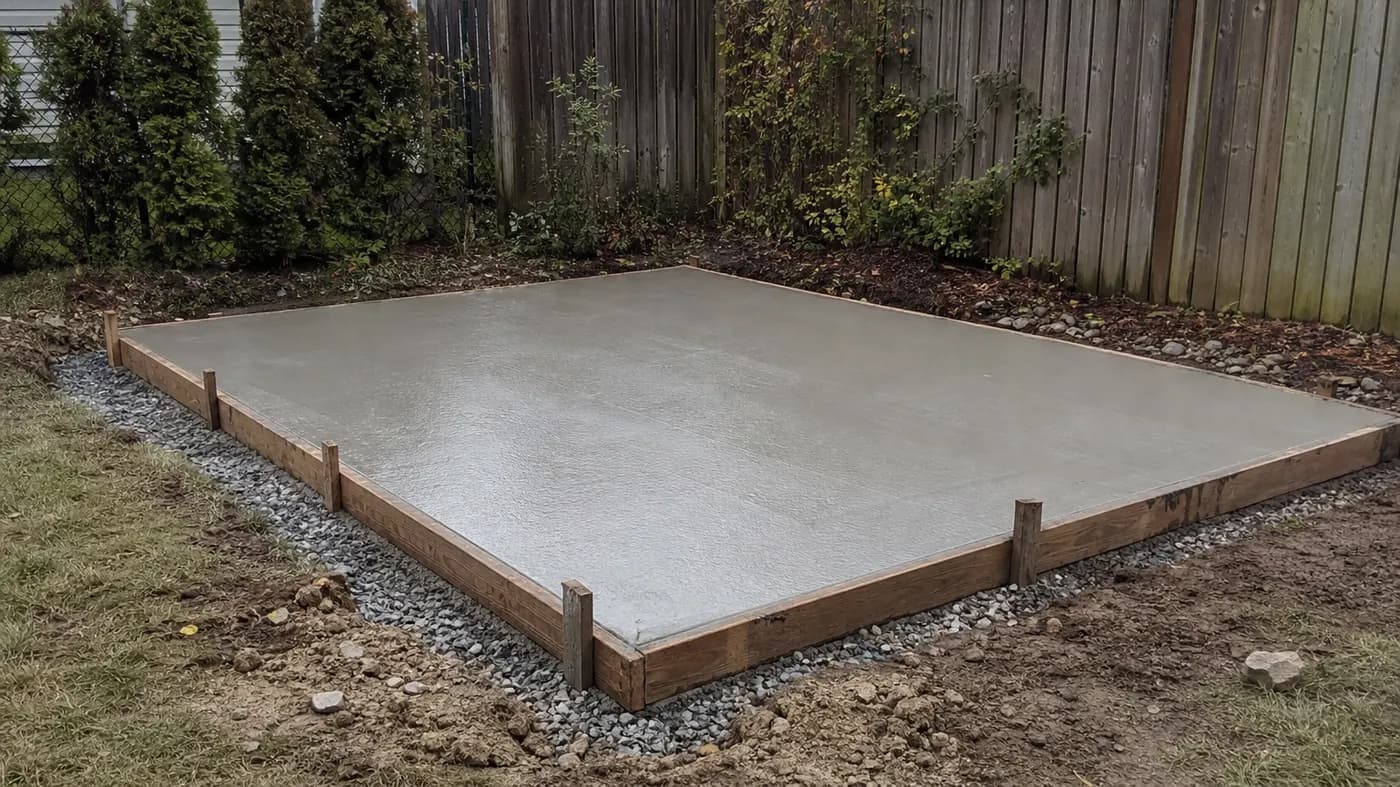
The base under the slab matters as much as the concrete. The photo above shows a slab form with gravel base at the edge. Ask what base material the contractor uses, how deep it is, and how it is compacted. If the pad sits near a downspout, a low spot or a sprinkler line, say so, because the contractor should account for how water moves around the pad.
Control joints and cracking
Every slab shrinks as it cures, and concrete cracks. Control joints are planned weak lines that steer the cracking. A common rule is to space joints 24–36 times the slab thickness, so a 4 inch slab gets joints about every 8–12 feet in each direction, and joints are cut at least one quarter of the thickness deep (1 inch for a 4 inch slab). A 10 by 10 foot shed pad may need only one joint or none; a larger pad needs more. Ask where the joints will go before the pour. If a crack shows up after the pour, see concrete repair.
Sacramento soil, heat and curing
Sacramento County has widespread hardpan and clay. The county's soils chapter describes a cemented hardpan (duripan) a few feet below the surface in places and notes that claypans and duripans are common in the low-terrace soils. San Joaquin and Redding soils have a high shrink-swell potential, which means they swell when wet and shrink when dry, and a slab sitting on them can move. Expansive clay and hardpan are common, so subgrade preparation matters. Foothill soils east of the valley are different again: clay, decomposed granite and very shallow rocky soil are typical. A slab on a sloped foothill yard may need extra grading or a retaining wall (see retaining walls).
Heat matters at pour time. Sacramento's normal July high is about 93–94°F, with about 20+ days a year at 100°F or hotter. Hot weather speeds up hydration and evaporation in fresh concrete. Curing means keeping the concrete continuously moist for about 7 days and shielding it from sun and wind, for example with damp burlap or curing blankets. Concrete kept moist for 7 days is cited as roughly 50% stronger than uncured concrete. Ask your contractor how curing will be handled and when it is ready for loads.
When a slab needs a permit or becomes a foundation
The California Building Code exempts sidewalks and driveways not more than 30 inches above adjacent grade, not over a basement or story below, and not part of an accessible route. A small ground-level pad is generally treated like flatwork, but pads are not named in that list, so confirm with your city or county. Exempt work still has to meet code and zoning, including setbacks.
Work that supports or attaches to a structure is different. A slab for a garage, workshop, addition or other building, or any work over a basement or a structure's foundation, is outside the flatwork exemption, and your building department decides what is required. See concrete foundations. The shed itself may also have its own size and placement rules, so ask the city or county before ordering one.
Planning a slab before you ask for quotes
A slab quote is only as good as the description behind it. Before contractors visit, work out the following so the quotes can be compared fairly.
- Exact footprint. Include a margin around the shed or equipment so the base extends beyond it. Ask the contractor how much.
- Access. Concrete trucks and equipment need a way in. A narrow side yard or a gate can change how the job is done and priced.
- What is there now. Lawn, gravel, old concrete or an existing pad. Removal of old concrete is about $2–$6 per square foot nationally.
- Level and drainage. Show the contractor the slope of the yard and where water runs.
- Utilities. Mark sprinkler lines, and tell the contractor where electrical or plumbing connections will run before the pour, since cutting into a slab later is costly and messy.
- Finish. A shed pad usually gets a broom finish for grip. A workshop floor may want a smoother surface.
Hiring a licensed concrete contractor for a slab
Sacramento Crest Concrete is a referral service. We pass your contact information to licensed local contractors, and you contract with and pay the contractor directly. Verify the license at cslb.ca.gov. The C-8 Concrete classification covers forming, pouring, placing and finishing flat concrete work.
- California caps the down payment at $1,000 or 10% of the contract, whichever is less.
- Most home improvement contracts have a three business day right to cancel (five if you are 65 or older).
- Ask for size, thickness, base, reinforcement, joint layout and finish in writing.
- Ask how the quote is structured for a small pad, including any minimum charge.
Main guide: concrete contractors in Sacramento.