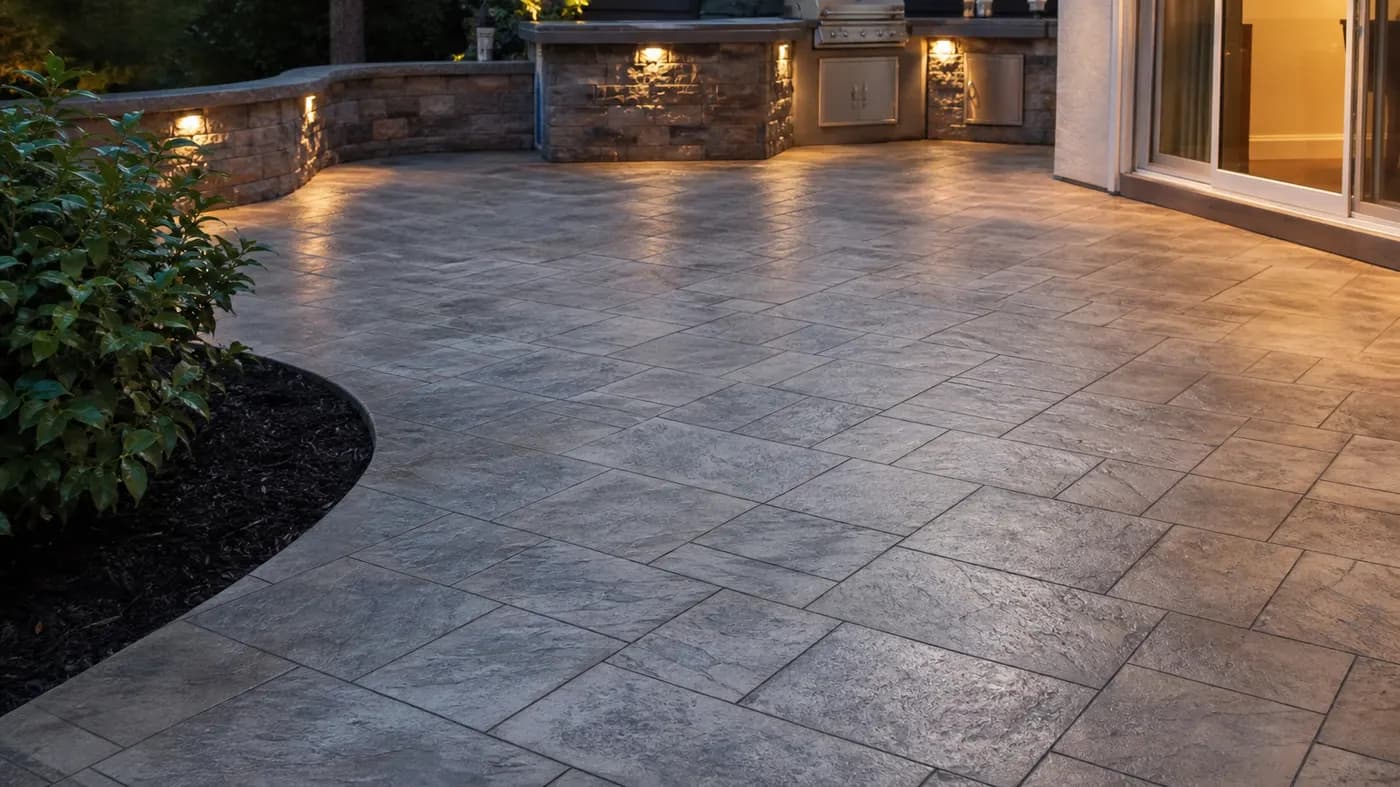
How stamped concrete is made
Stamped concrete starts like any other slab: base preparation, forms, reinforcement as the contractor specifies, and a pour. The difference is the finishing sequence. Color is added to the mix or worked into the surface, a release agent keeps the mats from sticking, and the stamp mats are pressed into the surface while it is workable. Joints are then cut and the surface is sealed once it has cured.
Because there is a timing window, stamped jobs depend heavily on the finishing crew and the weather. That is one reason stamped concrete costs more than a plain concrete patio or a broom-finish driveway, and why the choice of contractor matters more than the choice of stamp.
Stamped concrete patterns and color
Pattern names vary by brand, but the families are consistent. Roman slate and ashlar slate are popular slate patterns, and homeowners also ask for cobblestone, brick, flagstone and wood plank looks. The picture at the top of this page shows an ashlar slate pattern with charcoal antiquing over a warm gray base.
- Base color: integral color is mixed through the concrete; a color hardener is broadcast onto the surface. Ask the contractor which they use and how the color will wear.
- Accent or antiquing color: a second, usually darker, color applied by hand so the joints between faux stones read as shadow. That is the charcoal look in the photo.
- Border and field: many patios use a smooth or lightly textured border around a stamped center. See decorative concrete for scored, stained and textured alternatives.
Ask for a sample board or photos of finished jobs in the pattern and color you want. Color on a phone screen and color in afternoon sun are not the same thing.
Stamped concrete cost per square foot
These are typical national ranges from published cost guides. No Sacramento-specific pricing was found, so local quotes are what count. A contractor can visit, measure and quote the job, and a request through this site costs nothing.
| Item | Typical national range |
|---|---|
| Stamped concrete, installed | $12–$25 per sq ft |
| Colored concrete (add-on) | +$2–$6 per sq ft |
| Plain concrete patio, for comparison | $5–$8 per sq ft |
| Custom patio, for comparison | $11–$18 per sq ft |
| Sealing, with labor | $1.35–$2.50 per sq ft |
| Decorative or stamped overlay on existing concrete | $6–$20 per sq ft |
Published guides differ on stamped ranges (one summary shows $8–$26 and another $12–$28). Pattern complexity, number of colors, borders, and the size and shape of the area all move the number. The overall picture is in concrete cost in Sacramento.
Sealing and maintenance
Sealer is what gives stamped concrete its sheen and protects the color. Typical sealing costs about $1.35–$2.50 per square foot with labor, though that figure is a national average and the product and number of coats change it. Sealer wears, and a stamped surface that has gone dull or chalky usually wants resealing. Ask the contractor which sealer they plan to use, whether it is a glossy or matte finish, and how often to reapply.
A glossy sealed surface can be slippery when wet, so ask about a non-slip additive for steps, pool areas and slopes. For more, see concrete sealing. If a stamped surface is already worn or faded, concrete resurfacing is an option to discuss.
Heat, clay soil and cracking in the Sacramento area
Sacramento's normal July high is about 93–94°F, with about 20+ days a year at 100°F or hotter. Hot weather speeds hydration and evaporation in fresh concrete, and a stamped pour has less time to stamp and tool before the surface stiffens. Ask the contractor how they plan the pour and the curing, and keep the curing period in mind: concrete is generally kept continuously moist for about 7 days, and protected from sun and wind in the heat.
Underneath, Sacramento County has widespread hardpan and clay layers, and some soil series have a high shrink-swell potential. Expansive clay and hardpan are common, so subgrade preparation matters. A stamped slab is rigid and will crack somewhere, so joints should be laid out before the pour. Ask whether the control joints will be placed along pattern lines. Control joints are commonly spaced at 24–36 times the slab thickness, and cut at least a quarter of the way through.
Where stamped concrete fits and where it does not
Good fits
- Backyard patios where you want a stone or slate look without the cost of natural stone.
- Front entries and walkways that should match the character of the house.
- Pool surrounds, with a slip-resistant sealer (see concrete pool decks).
- Driveways, where stamped borders or bands add detail to a plain field.
Weigh carefully
Stamped concrete is not a good match for a limited budget when the same money could pay for a plain concrete patio that is larger. It also commits you to periodic sealing, and color matching on repairs is difficult. If you are not sure, a plain broom-finish slab with a stamped or colored border is a common middle path.
Stamped, plain or exposed aggregate: how the options compare
Stamped concrete is one of several ways to get a finished look. The ranges below are typical national figures, and the right choice depends on the budget, the sun and wear the surface will see, and how much upkeep you want.
| Option | Typical national range | Trade-off |
|---|---|---|
| Plain broom finish (driveway or patio) | $5–$12 per sq ft | Lowest cost and simplest; see concrete driveways |
| Exposed aggregate | +$3–$8 per sq ft over base cost | Pebbled texture with natural color; see exposed aggregate concrete |
| Colored or stained | +$2–$6 per sq ft | Color without a pattern; stain is covered under decorative concrete |
| Stamped | $12–$25 per sq ft | Pattern and color together; needs sealing and a skilled finish |
Questions to ask before you approve a stamped quote
- Which pattern and which colors, and can you see a finished job or a sample board in the same combination?
- Is the color integral, a surface hardener, or both, and what is the accent color?
- Where will the control joints go, and how will they fit the pattern?
- What sealer is used, is it glossy or matte, and when should it be reapplied?
- How will the pour be timed and cured in hot weather?
- Is a non-slip additive included for steps, pool areas or slopes?
- Who handles any permit or right-of-way work, and what is in writing?
Permits and hiring for stamped work
California's building code generally exempts sidewalks and driveways not more than 30 inches above adjacent grade, not over a basement or story below, and not part of an accessible route. Patios are not named in that list, so cities treat them under their own rules. Citrus Heights, for example, does not list patios as exempt on its page. Confirm with your city or county, and note that a driveway approach crossing the public right-of-way has its own permit (see concrete driveways).
- Sacramento Crest Concrete is a referral service. You contract with and pay the contractor directly.
- Check the license at cslb.ca.gov. The C-8 Concrete classification covers forming, pouring, placing and finishing flat concrete work.
- California caps the down payment at $1,000 or 10% of the contract, whichever is less.
- Ask to see finished stamped work in the pattern you want, and get the color, pattern, sealer and joint layout in writing.
Main guide: concrete contractors in Sacramento.