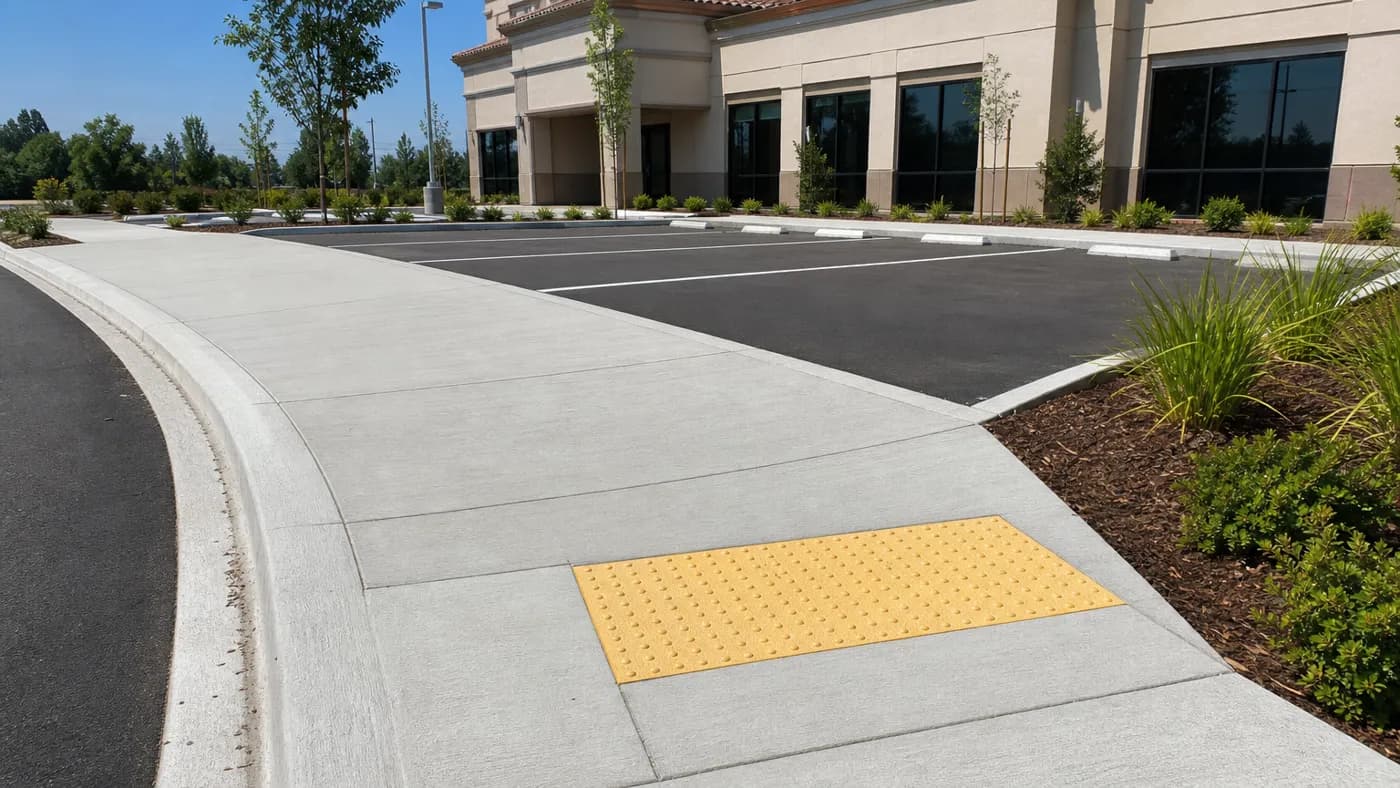
Typical commercial concrete jobs
- Sidewalk and walkway replacement where panels have lifted or cracked
- Accessible curb ramps, landings and parking-stall access aisles
- Curb and gutter, wheel stops and parking-lot repairs
- Dumpster enclosure pads and approach aprons that take truck loads
- Slabs for equipment, storage buildings and tenant improvements
- HOA common-area walks, pool decks and entries
In California, concrete flatwork is typically done under a C-8 Concrete license, which covers mass, pavement, flat and other concrete work. Some commercial jobs are part of a larger project under a general contractor (A or B license). Check the license and classification at cslb.ca.gov before signing.
Accessible routes and slope limits
Commercial walks, ramps and parking access are usually part of an accessible route, and that changes the job. California's building code permit exemption for sidewalks and driveways does not apply to flatwork that is part of an accessible route, so expect a permit and an inspection. The federal 2010 ADA Standards set the core slope limits:
| Surface | Limit (2010 ADA Standards) |
|---|---|
| Walking surface running slope | Not steeper than 1:20 (section 403.3) |
| Walking surface cross slope | Not steeper than 1:48 (section 403.3) |
| Ramp running slope | Not steeper than 1:12 (section 405.2) |
| Ramp cross slope | Not steeper than 1:48 (section 405.3) |
| Rise per ramp run | 30 inches maximum (section 405.6) |
California also enforces its own accessibility chapter of the building code, and the local plan reviewer decides what applies to your site. A finished surface that misses these numbers by a fraction can fail inspection and have to be torn out, so ask how the contractor sets and checks grades before the pour.
Permits and right-of-way work
Work in the public sidewalk or street needs an encroachment permit: in the City of Sacramento, any work in the public right-of-way does, and a new or modified curb cut needs a driveway permit with a site plan, a traffic control plan and proof of liability insurance. In unincorporated Sacramento County, SacDOT issues encroachment permits. Roseville, Elk Grove, Folsom and the other cities each run their own counters. Work on private property that is part of an accessible route, or that is more than 30 inches above grade, also typically needs a building permit.
Scheduling around a business
Concrete needs time before it carries traffic, and keeping it moist for about 7 days gives it the best start, so plan closures in phases. In Sacramento summers, with about 20+ days a year at 100°F or hotter, many contractors pour at dawn. Ask for a phasing plan that keeps an entrance and an accessible route open, how long each section will be closed to foot and vehicle traffic, and who handles barricades and signage.
Grinding and saw-cutting concrete create silica dust covered by Cal/OSHA's silica standard; ask how dust will be controlled near open doors and air intakes.
What to send with a request
- Property address and type (retail, office, HOA, multifamily, church)
- What needs work: sidewalk panels, ramp, curb, slab, approach, with rough sizes
- Whether the work is in the public sidewalk or street, or entirely on private property
- Any letter, notice or report that prompted the work, such as a city sidewalk notice or an accessibility survey
- Timing limits: hours the business must stay open, tenant notice periods
Related pages: concrete walkways and sidewalks, concrete curbing, concrete removal and concrete slabs. Send a request and a licensed contractor can walk the site and quote in writing.
Main guide: concrete contractors in Sacramento.