Private walkway or public sidewalk: know which you have
A concrete walkway on your own lot, such as a front entry path, a side-yard path to the gate or a path across the back yard, is private flatwork. You decide the width, the route and the finish, subject to code and any zoning setbacks. A concrete sidewalk in the strip between your property line and the street is usually part of the public right-of-way, even though many homeowners are expected to keep it in good repair. That difference drives almost everything else on this page.
If you are not sure where your property line sits, check your parcel map or ask a contractor to confirm it before pricing starts. A walkway that stays on your lot is a simple flatwork job. Work that touches the sidewalk, the curb or the driveway approach is right-of-way work and brings the city or county into the picture.
Private walkways on your lot
- Front entry walks from the driveway or street to the door.
- Side-yard paths along the house, often narrow and curved around utility boxes or air conditioning units.
- Garden and back-yard paths to a patio, shed or gate. If the path ends at a patio, see concrete patios.
- Replacement of an old, cracked or stained path with a new pour in the same footprint.
Public sidewalks in the right-of-way
Sidewalk panels lifted by roots, cracked by age or sunk at a joint are the usual reasons homeowners search for sidewalk work. The City of Sacramento municipal code section 12.12.020 requires an encroachment permit for any work in the public right-of-way, and that includes sidewalk replacement. Unincorporated Sacramento County neighborhoods use SacDOT encroachment permits for driveway approaches, and other cities set their own procedures. Confirm with your city or county public works office before any work in the street-side strip.
What a walkway job involves
A contractor measures the route, marks the edges, strips sod or old concrete, grades and compacts the subgrade, sets wood forms, places the concrete and finishes it. The finishing steps matter on a walkway because it is the surface people walk on every day: edging, tooled or saw-cut joints, and a texture that grips when wet. Compacted subgrade is the part you will not see afterward, and it is where a lot of later settling and cracking starts.
Sacramento County has widespread cemented hardpan and clay layers, and some soil series have high shrink-swell potential. Hardpan and expansive clay are common here, so subgrade preparation matters. Ask the contractor what they do under the slab, and who is responsible if a section settles.
Joints and curing
Concrete cracks as it shrinks. Control joints give it a planned place to do so. A common guideline spaces control joints at 24 to 36 times the slab thickness in inches, so a 4 inch slab gets a joint roughly every 8 to 12 feet, cut at least one quarter of the slab depth. On a narrow walkway the joints often run straight across at regular intervals, which is why many walks look like a row of rectangles.
Fresh concrete also needs to cure. Keeping it moist for about 7 days and shielding it from sun and wind in hot weather helps it gain strength. Sacramento's normal July high is about 93 to 94 F, with about 20 or more days a year at 100 F or hotter, so a pour in summer needs more protection than one in spring.
Finishes for concrete walkways
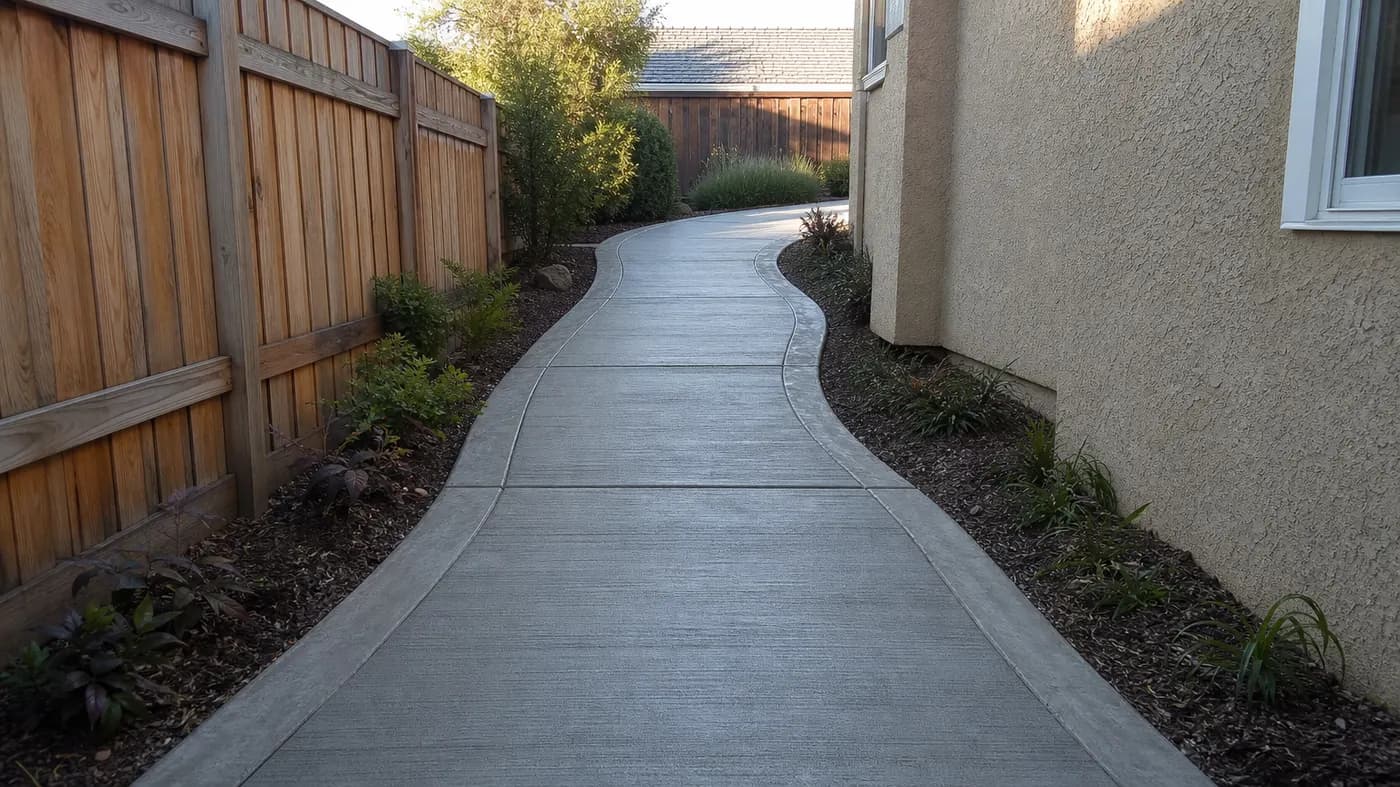
Most homeowners start with a plain broom finish, then decide whether a step up in appearance is worth the added cost. The photo above shows a standard broom-finish side-yard walkway with tooled edges, one of the simplest and most common choices.
| Finish | What it looks like | Notes |
|---|---|---|
| Broom finish | Fine parallel texture, light gray | Good grip when wet; the baseline price in most quotes |
| Exposed aggregate | Pebbles revealed in the surface | See exposed aggregate concrete; sealing is recommended |
| Stamped | Pattern pressed in to look like slate, brick or stone | See stamped concrete; often colored |
| Colored or stained | Earth tones, solid or mottled | See decorative concrete for stains, borders and scoring |
If your walkway climbs to a front door, ask about concrete steps in the same pour so the colors and textures match.
What concrete walkways cost (typical national ranges)
These are typical national ranges, not Sacramento quotes. Local pricing varies with access, demolition, finish and permit needs, and it only comes from a contractor who visits and measures. Use the figures to sanity-check a quote, not to budget to the dollar.
| Item | Typical national range |
|---|---|
| Concrete sidewalk or walkway, installed | $6 to $14 per sq ft |
| Decorative or stamped walkway | $12 to $20+ per sq ft |
| Exposed aggregate add-on | +$3 to +$8 per sq ft |
| Colored concrete add-on | +$2 to +$6 per sq ft |
| Removal of old concrete | $2 to $6 per sq ft |
Small jobs often cost more per square foot than large ones because crews have fixed setup costs. If the old walkway has to come out first, read about concrete removal so the demolition line on your quote makes sense.
Permits for walkways and sidewalks
The California Building Code lists sidewalks and driveways not more than 30 inches above adjacent grade, not over a basement or story below and not part of an accessible route among work that is generally exempt from a building permit. Roseville's published exemption handout repeats that wording, and Citrus Heights lists walks and driveways under 30 inches as exempt. Exempt work must still meet code and zoning, so setbacks still apply. Treat this as a general rule and confirm with your city or county.
A private walkway on your lot is generally exempt in the City of Sacramento unless the property is in a design review or preservation district or is a historic landmark, but that comes from a secondary source, so confirm before you start. Anything in the right-of-way is a different category: it needs an encroachment permit, and the contractor typically handles the application.
Roseville publishes minor sidewalk and driveway encroachment requirements that include 48 hours notice to the inspector, a call to USA 48 hours before removing concrete and compacted subgrade, with sidewalk concrete specified at 6 inches thick. That document references older standards, so the numbers may be superseded. Ask the city for the current version before quoting them to a contractor.
Hiring for a walkway or sidewalk job
Sacramento Crest Concrete passes your contact details and project notes to licensed contractors who work in your area. You contract with the contractor and pay the contractor directly. We do not pour, quote, contract or warranty any work, and a request costs you nothing.
- Check the license at cslb.ca.gov before you sign. Flatwork usually falls under the C-8 Concrete classification.
- California limits a home improvement down payment to $1,000 or 10 percent of the contract, whichever is less.
- Home improvement contracts generally carry a three business day right to cancel, or five if you are 65 or older.
- For sidewalk work in the right-of-way, ask who pulls the encroachment permit and who carries the required insurance.
Ready to compare options? Send a request with a few photos and the length of the walkway.
Main guide: concrete contractors in Sacramento.