What exposed aggregate concrete is
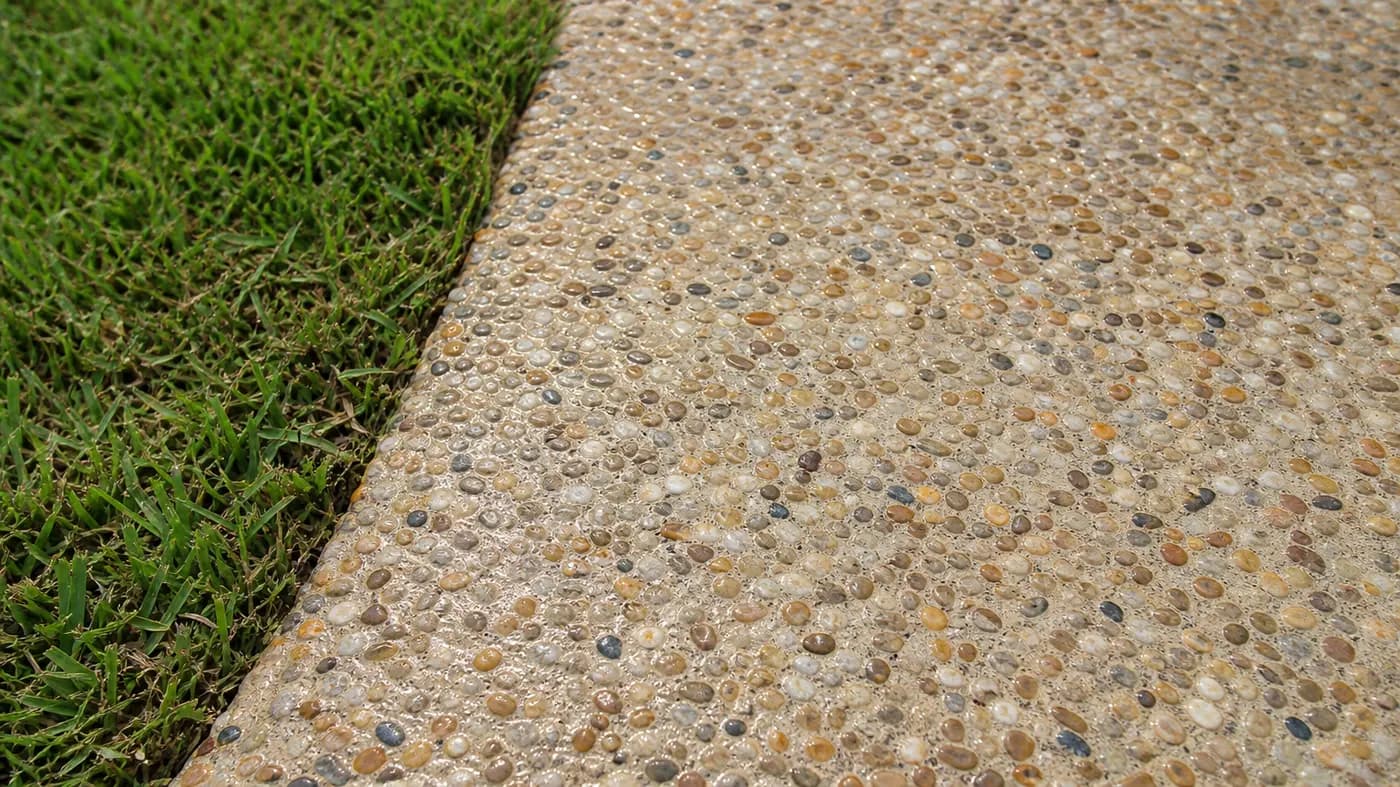
Ordinary concrete is cement, sand, water and stone. On a plain slab the cement paste covers the stone and the finisher smooths or brooms the top. In exposed aggregate concrete the paste at the surface is removed after the slab firms up, so the stones show. The result is a textured surface with a pebbly look, like the walkway in the photo above, where rounded tan and gray river pebbles show through.
The finish suits people who want something more interesting than plain gray without the pattern of stamped concrete. The stones also give the surface more grip than a trowel finish, which is one reason the look shows up on walkways and around pools.
Standard vs seeded exposed aggregate
There are two common ways to get the look. In a standard method, the stone is part of the concrete mix throughout, and the contractor exposes it at the surface. In seeded exposed aggregate, the contractor broadcasts selected stones onto the freshly placed concrete, presses them in and then exposes them. Seeding lets a contractor choose a decorative stone that would be expensive to use all the way through the slab. Ask which method a quote is based on and what stone is planned, since the stone color and size set the look.
Where homeowners use it
- Driveways. A pebble finish breaks up a large expanse of gray. See concrete driveways for the plain version and the questions around thickness, joints and the driveway approach.
- Walkways and entries. Front walks and paths are a natural fit; see concrete walkways and sidewalks.
- Patios and pool decks. Grip is useful wherever feet are wet, though a rough surface can be hard on bare feet. See the concrete pool decks page for the tradeoffs.
If your home has a design review or association with rules about exterior finishes, check them before you choose a stone color.
How the finish is done and why timing matters
The exposing step is time sensitive. The contractor has to remove the surface paste after the concrete has firmed enough to hold the stones but before it hardens fully. Too early and stones get dislodged. Too late and the paste will not come off cleanly. Hot, dry weather shortens that window, and Sacramento's normal July high is about 93 to 94 F with about 20 or more days a year at 100 F or hotter. Ask how the contractor handles a pour on a hot day, such as pouring early, and how they will protect the slab afterward.
Curing still matters after the surface is exposed. Concrete kept moist for about 7 days gains strength better than concrete left to dry fast, and in hot weather the slab should be shielded from sun and wind. Ask what the plan is.
Sealing exposed aggregate
Sealer is common on exposed aggregate. It deepens the color of the stones, as in the freshly sealed walkway in the photo, and it helps keep stains and water out of the porous paste between them. A sealer that is too glossy on a walking surface can be slick when wet, so ask about a finish made for foot traffic.
Our national reference for sealing is about $1.35 to $2.50 per square foot with labor. Sealer wears with sun and traffic and needs to be redone at intervals, so ask the contractor what they would use and when they would reapply. For more detail see concrete sealing.
What exposed aggregate costs (typical national ranges)
These are typical national ranges, not Sacramento quotes. Local pricing comes from contractors who measure and quote your job, and prices vary with access, stone choice, demolition and the size of the pour.
| Item | Typical national range |
|---|---|
| Plain or broom-finish concrete driveway, installed | $6 to $12 per sq ft |
| Exposed aggregate add-on to the base price | +$3 to +$8 per sq ft |
| Basic decorative driveway, including exposed aggregate | $10 to $15 per sq ft |
| Colored concrete add-on | +$2 to +$6 per sq ft |
| Sealing, with labor | about $1.35 to $2.50 per sq ft |
Add-ons stack, so a colored, seeded and sealed surface costs more than any one of them. Ask for the add-ons itemized so you can see where the money goes. If you are comparing finishes, the decorative concrete page covers color, stain and texture options side by side.
Choosing stone, color and surface
The stone does most of the visual work, so it is worth slowing down here. River pebbles, like the rounded tan and gray ones in the photo, give a soft, mixed look. Crushed or angular stone looks different and feels different underfoot. Stone size changes both the texture and how the slab looks from the street. Ask the contractor for physical samples of the stone you are considering and look at them dry and wet, in your own yard, in full sun and in shade.
Also consider how the surface will be used. A driveway takes tire turning and oil, a walkway takes feet and shoes, and a pool surround takes wet bare feet. Each of those points to a different balance of roughness, sealer and stone size. A contractor who has worked on all three can explain the tradeoffs better than a catalog can.
- Match the stone colors to the roof, trim and stucco so the slab looks planned, not added on.
- Ask how a mock-up or test area would be handled before the full pour.
- Ask how the finish edge will look where the slab meets a plain border, a step or a planter.
Repairs, wear and replacement
Exposed aggregate is harder to patch invisibly than a broom finish, because a patch has to match both stone and color. Small cracks can often be filled, but the repair may remain visible. Stones that pop out or a surface that has worn smooth may call for resurfacing or a new section. See concrete repair for what is typical, and keep in mind that the contractor will need to see the slab to judge.
Permits and working with a licensed contractor
The California Building Code lists sidewalks and driveways not more than 30 inches above adjacent grade, not over a basement or story below and not part of an accessible route as exempt from a building permit. Exempt work must still meet code and zoning. Work in the public right-of-way is different: the City of Sacramento requires an encroachment permit under municipal code 12.12.020, and unincorporated Sacramento County uses SacDOT encroachment permits for driveway approaches. Confirm with your city or county.
Sacramento Crest Concrete passes your contact details to licensed contractors in your area. You contract with the contractor and pay the contractor directly. We do not pour, quote, contract or warranty any work, and a request costs nothing. Verify the license at cslb.ca.gov before you sign. Concrete flatwork generally falls under the C-8 Concrete classification. California limits a home improvement down payment to $1,000 or 10 percent of the contract, whichever is less. To start, send a request.
Main guide: concrete contractors in Sacramento.