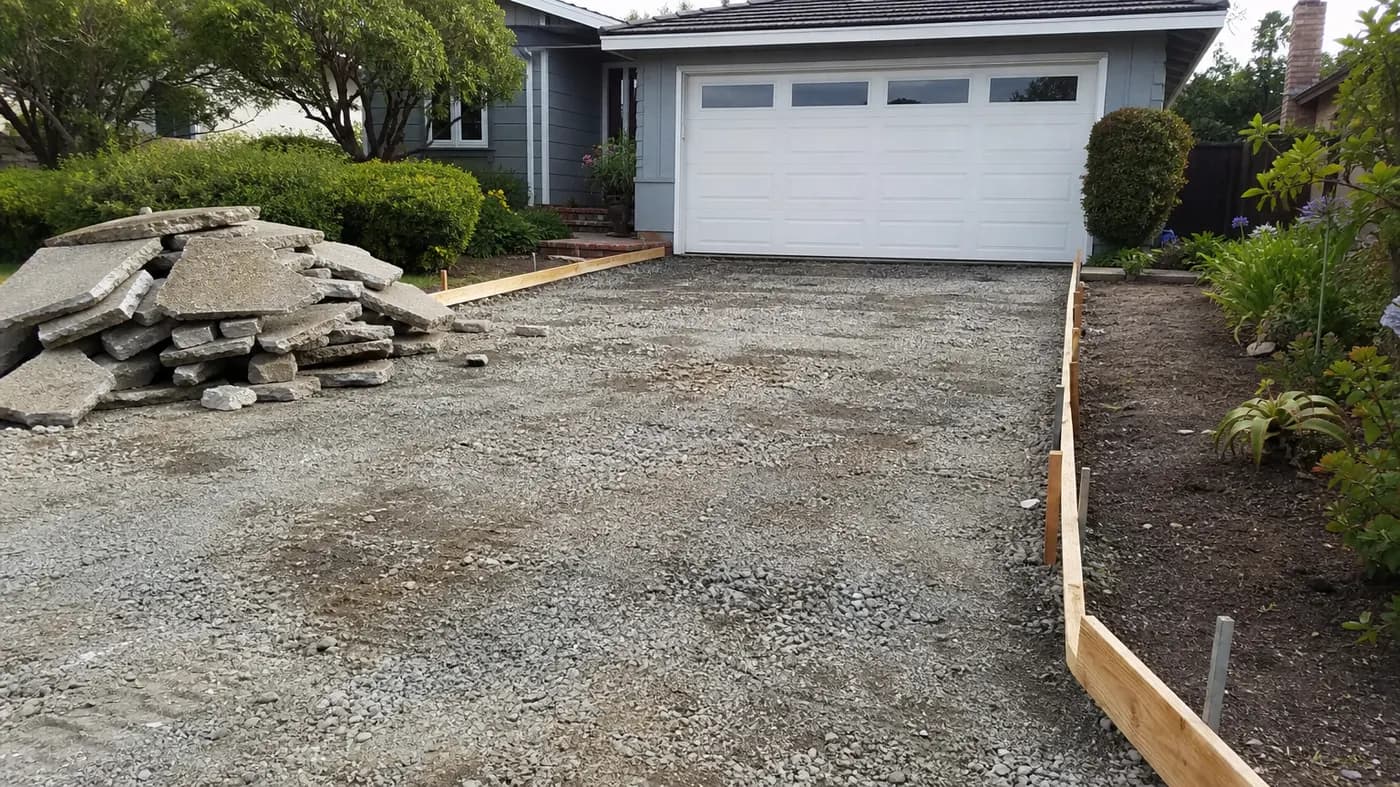
Replace the driveway, or repair it?
Replacement is a bigger commitment than repair, so it is worth confirming that repair will not do. Narrow, stable cracks and surface wear can often be handled with concrete repair or concrete resurfacing. A section that has sunk may be raised by concrete leveling. Replacement is the more likely answer when the driveway is broken into many pieces, when it has heaved or settled because of the base, or when you want a different size, shape or finish.
Sacramento County has widespread cemented hardpan and clay layers, and some soils have high shrink-swell potential. A driveway that keeps cracking in new places after repairs may be telling you about the base. When the old slab comes out, that is the moment to fix it, so ask each contractor what they will do with the ground under the new pour.
How driveway replacement works
- Permit check. The contractor or you confirm whether the work touches the driveway approach in the public right-of-way (see the permit section below).
- Removal. The old concrete is broken up and hauled away. This is the step in the photo above's before state, with broken slabs stacked and the base exposed.
- Base and forms. The base is graded and compacted, and wood forms define the edges.
- Pour and finish. Concrete is placed, finished, and control joints are cut or tooled in.
- Curing and cleanup. The slab is kept moist and protected while it cures, then you wait before driving on it.
A new driveway is typically at least 4 inches thick for passenger vehicles, with commonly specified strengths of 3,500 to 4,000 psi. Control joints are typically spaced at 24 to 36 times the slab thickness in inches, so about every 8 to 12 feet on a 4 inch slab, and are cut at least one quarter of the thickness deep. Ask what thickness, strength and joint layout the contractor plans, and ask when you can walk and drive on it. Do not rely on a number from a website for that last one, because it depends on the mix and the weather.
What replacement costs: two separate national ranges
Replacement pricing is the sum of two different jobs, and national guides price them separately. We list them as two typical national ranges and do not publish a combined figure, because we have no source that confirms one. Sacramento pricing comes from local quotes.
| Job | Typical national range | Notes |
|---|---|---|
| Removal of the old driveway | $2 to $6 per sq ft | Low end for unreinforced concrete, up to the high end with rebar; one national average job is about $1,380 |
| New plain or broom-finish driveway | $6 to $12 per sq ft | Installed price for the new pour |
| New stamped driveway | $12 to $25 per sq ft | Installed price for a stamped pour |
| Exposed aggregate add-on | +$3 to +$8 per sq ft | Added to the base price; see exposed aggregate concrete |
| Colored concrete add-on | +$2 to +$6 per sq ft | Added to the base price |
Removal and the new driveway are priced independently, so ask each contractor to break their quote into at least those two lines. Check whether the quote also covers hauling, base work, the driveway approach, permit fees and any extra work around trees, irrigation lines or drainage. For the new pour on its own, see concrete driveways and the concrete cost guide.
Permits, the driveway approach and the right-of-way
The California Building Code lists driveways not more than 30 inches above adjacent grade, not over a basement or story below and not part of an accessible route as exempt from a building permit, but exempt work must still meet code and zoning. The part of a driveway that crosses the sidewalk and meets the street, the approach, is in the public right-of-way and is handled differently.
City of Sacramento
The city's driveway permit instructions say no permit is required for driveways that abut a rolled (mountable) curb or an alleyway, though the driveway must still meet code. A driveway permit is required for a new or modified driveway that needs a curb cut, and an encroachment permit applies when reconstructing an existing driveway inlet without changing its width. Under city code 17.508.050, single-car driveways are 10 to 12 feet wide and two-car driveways up to 20 feet, with 20 feet of length from the property line (18 feet in the Central City). No driveway may sit within 10 feet of a pedestrian ramp. The application package includes a site plan, a traffic control plan and proof of liability insurance, and work may start only after the permit is issued. City code 12.12.020 requires an encroachment permit for any work in the public right-of-way. Confirm current requirements with the city's Development Engineering office.
Unincorporated Sacramento County and other cities
In unincorporated areas such as Carmichael, Fair Oaks, Antelope and Orangevale, driveway approaches in the county right-of-way need an encroachment permit from SacDOT, obtained before construction. Elk Grove requires an encroachment permit for driveway approach work in the public right-of-way. Roseville publishes minor sidewalk and driveway encroachment requirements, though that document references older standards, so confirm with the city. Other cities set their own rules, so confirm with your city or county before work starts.
Widening a driveway
Widening is common, but a wider driveway at the street may change the approach and trigger the width limits and permits above. Raise it with the contractor early.
Timing, heat and curing
A replacement means the driveway is out of service for some time, and you will want to plan where to park. Sacramento's normal July high is about 93 to 94 F, with about 20 or more days a year at 100 F or hotter. Fresh concrete loses moisture faster in heat, so keeping it moist for about 7 days and shielded from sun and wind in hot weather matters. Ask how the contractor will schedule the pour in summer and how long they advise staying off it.
Before you request quotes
- Measure the length and width, or give a rough estimate, so each contractor starts from the same size.
- Note whether the driveway meets a rolled curb, a vertical curb with a curb cut, or an alley.
- Note trees, irrigation lines, gas or electric meters, and any slope toward the garage.
- Decide in advance whether you want the same size and finish, a wider driveway, or a decorative upgrade.
- Plan where cars will be parked while the work is under way.
Giving every contractor the same information makes the quotes easier to compare line by line.
Working with a licensed contractor
Sacramento Crest Concrete passes your contact details to licensed contractors in your area. You contract with the contractor and pay the contractor directly. We do not remove, pour, quote, contract or warranty any work, and a request costs nothing. A contractor can visit to measure and quote.
- Verify the license at cslb.ca.gov. Driveway work generally falls under C-8 Concrete, and some firms hold C-12 Earthwork and Paving.
- California limits a home improvement down payment to $1,000 or 10 percent of the contract, whichever is less.
- Home improvement contracts generally include a three business day right to cancel (five for buyers 65 or older).
- Ask who applies for and pays for any encroachment permit, and get it in writing.
To get quotes, send a request with photos and the approximate length and width.
Main guide: concrete contractors in Sacramento.