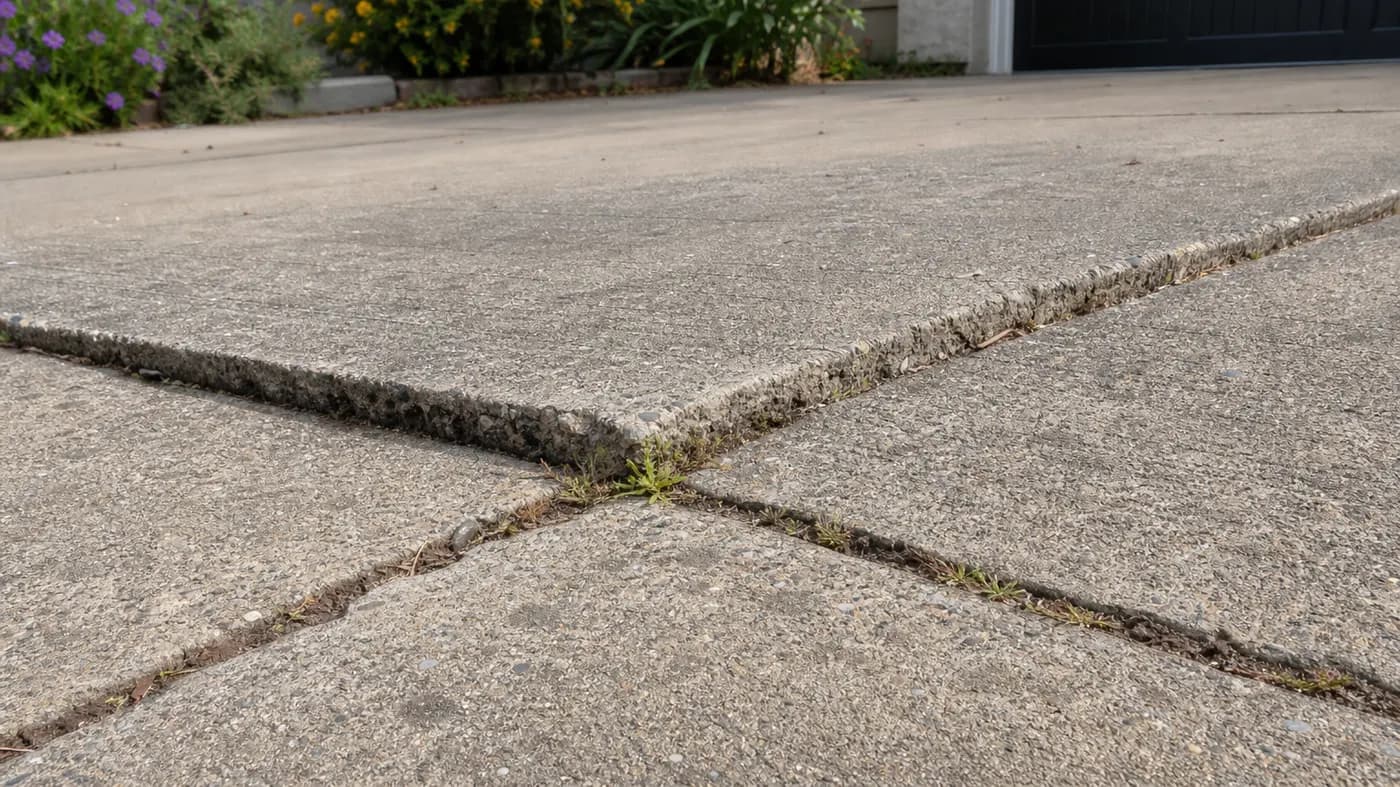
Why concrete cracks and moves
All concrete shrinks as it cures, and a plain slab will crack somewhere unless joints tell it where to. Control joints are cut or tooled into the surface for that reason. A common guideline spaces them at 24 to 36 times the slab thickness in inches, so a 4 inch slab gets a joint about every 8 to 12 feet, cut at least one quarter of the thickness deep. Cracks that wander away from the joints often point to a problem with the joint layout, the curing or the ground underneath.
Hot weather matters too. Faster loss of moisture from fresh concrete can cause problems, and Sacramento's normal July high is about 93 to 94 F with about 20 or more days a year at 100 F or hotter. Keeping new concrete moist for about 7 days and shielded from sun and wind helps it cure properly. If a slab cracked early in its life, how it was cured is a fair question for the original contractor.
The ground underneath
Sacramento County has widespread cemented hardpan and clay layers, and some of its soil series, including the Redding and San Joaquin series, have high shrink-swell potential. Clay that swells when wet and shrinks when dry moves slabs, and hardpan can hold water near the surface. Water that is allowed to run under a slab, or a base that was not compacted, shows up later as settling, heaving and a lifted edge like the one in the photo above. Fixing the crack without fixing the cause is the most common reason a repair does not last.
Roots, water and age
Tree roots can lift a slab, downspouts and sprinklers that soak the base can soften it, and an older slab has simply had more years of heat, water and traffic. A contractor who visits can often tell which of these is at work by where the cracks run and which parts of the slab have moved.
Repair options and when each one fits
Repairs run from cosmetic to structural. The table lists what homeowners are usually choosing between. Typical national ranges are included only where our reference sources support one.
| Problem | Common fix | Typical national range |
|---|---|---|
| Hairline or narrow stable cracks | Fill or seal the crack | No figure published here; get local quotes |
| Chipped edges, small broken corners | Patch | No figure published here; get local quotes |
| Worn, stained or scaling surface on a sound slab | Resurface with an overlay | $3 to $9 per sq ft ($6 to $20 decorative) |
| Slab that has sunk or tilted but is otherwise intact | Raise it (mudjacking or foam leveling) | $3 to $8 per sq ft; typical job about $660 to $1,900 |
| Widely cracked, broken or badly heaved slab | Remove and replace | Removal $2 to $6 per sq ft, plus the new slab |
We do not publish a price for crack repair because our reference sources did not support one. Cost varies widely with the crack, the product and the access, so a quote after a site visit is the only reliable number.
Crack repair and patching
Narrow cracks that are not moving can often be filled or sealed to keep water and debris out. Sealing a crack does not stop a slab from moving, and a crack that is widening, offset at the edges or growing is telling you something about the base. Ask the contractor whether the crack is stable and what is causing it. See concrete sealing for how sealers fit into maintenance.
Patching chipped corners and small broken areas is a matter of removing the loose material, cleaning, bonding and filling. Repairs will usually be visible because new concrete rarely matches the weathered color of an old slab, and on decorative finishes like stamped or exposed aggregate a patch is harder to hide.
Resurfacing, leveling and replacement
Resurfacing
A resurfacing overlay renews the surface of a slab that is structurally sound but worn, stained or scaling. It does not fix a slab that is moving. See concrete resurfacing.
Leveling
A sunken slab beside a higher neighbor creates a trip edge. The slab can sometimes be raised by pumping material beneath it through small holes. Our national reference ranges are about $3 to $8 per square foot, or about $660 to $1,900 for a typical job. If the soil under it keeps moving, the slab may sink again. See concrete leveling.
Replacement
When a slab is broken into many pieces or has failed at the base, replacement is usually the honest answer. For a full driveway, see driveway replacement for how removal and new concrete are priced separately, and concrete removal for demolition.
Foundation and structural cracks
This page covers flatwork such as driveways, walks, patios and steps. Cracks in a house foundation or stem wall can be structural and are generally handled by specialists, not by a surface repair. If cracks in the house walls, doors that stick or a foundation that shows displacement are part of the picture, say so in your request so it reaches the right person. For new footings and slabs, see concrete foundations.
What to note before you request a repair
A few observations make a site visit more useful and help a contractor tell you, early, whether you are looking at a patch, a lift or a replacement.
- Where do the cracks run? Straight lines along joints behave differently from cracks that wander or branch.
- Is any section higher or lower than its neighbor, and by how much? A lifted edge at a joint is a trip hazard.
- Is the crack wider at one end, or has it grown since you first noticed it?
- Is there a tree, downspout, sprinkler head or low spot near the damage?
- Is the surface flaking, scaling or crumbling, or is it only cracked?
- How old is the slab, and has anyone repaired it before?
Photos taken in the morning or evening, when low light shows height differences, are more helpful than midday shots.
Permits and working with a licensed contractor
Repair work on an existing slab on your own lot usually does not need a building permit, and the California Building Code lists sidewalks and driveways not more than 30 inches above adjacent grade as exempt. Work in the public right-of-way is different: sidewalk and driveway approach repairs in the City of Sacramento fall under municipal code 12.12.020, which requires an encroachment permit, and the city lists an encroachment permit for reconstructing an existing driveway inlet. Unincorporated Sacramento County uses SacDOT encroachment permits. Confirm with your city or county.
Sacramento Crest Concrete passes your contact details to licensed contractors in your area. You contract with the contractor and pay the contractor directly. We do not repair, quote, contract or warranty any work, and a request costs nothing. Verify the license at cslb.ca.gov. Concrete flatwork generally falls under the C-8 Concrete classification. California limits a home improvement down payment to $1,000 or 10 percent of the contract, whichever is less.
Send a request with a few photos of the damage, taken from standing height and close up.
Main guide: concrete contractors in Sacramento.